The Festival Series Explains: Sviten Special



Sviten Special is a variant of the game called "Drawmaha" and is a unique, split pot poker format that combines elements of both Five Card Omaha and Five Card Draw. It’s an exciting game which merges community cards with draw mechanics, making it a favourite among mixed game players and those seeking a fresh challenge or a break from the mundanity of Texas Hold’em.
Sviten Special is typically played with a pot-limit betting structure (similar to Pot-Limit Omaha) and this is one of the ways in which it differentiates itself from Drawmaha, which is popular in poker rooms in the USA, but usually with a limit betting structure.
Although Sviten Special is usually played for small stakes, it creates a lot of action and very big pots often occur.
History of Sviten Special
Sviten Special originated in Sweden and expanded into Finland and the rest of Scandinavia before gradually gaining popularity across Europe. Its origins date back to the early 2000s when a poker player named Anders Bengtsson opened a poker club in Stockholm with the name: The Sviten Club. This was a regular poker club and most of the members enjoyed playing Texas Hold’em, which had already established itself as the dominant poker variant by then.
The Sviten club started off in a small venue, catering to a small group of no more than 15 regular players. However the club grew in popularity and moved to larger premises more than once, before it closed down in 2007. But before it shut its doors for good, it had given birth to a poker variant that now immortalises the club that it was named after.
Anders, who is better known in the Swedish poker community as Bengan, spoke to The Festival about the invention of Sviten. Bengan explained that he invented Sviten Special in 2004. The Sviten poker club had many members who liked to play mixed games and one night, with just four players left playing, Bengan proposed a game that ended up becoming Sviten Special. Combining five card draw and Omaha, the game was so well received that they decided to play it again the next day. As a new game it sparked the curiosity of other members and the game quickly became a firm favourite within the club.
Rules of Sviten Special - How to Play
Setup
- Players: 2-7 players.
- Deck: Standard 52-card deck.
- Blinds: Small blind, small blind, and big blind are posted by the players to the left of the dealer. (Yes, in Sviten Special there is played with three blind positions)
Dealing
- Each player is dealt five hole cards, as per five card draw.
- A round of betting begins, starting with the player to the left of the big blind.
Community Cards
- After the initial betting round, three community cards are dealt face-up on the board (the flop). Note that you don't need to burn a card in Sviten.
- Another round of betting takes place
Discard Phase
- Each player then has the option to discard any number of their hole cards and draw new ones from the deck, aiming to improve their hand. Players must declare the number of cards they wish to discard and place them in front of them before the dealer starts replacing cards.
- If a player chooses to draw more than one card, the new cards are dealt face down, so only the player receiving them can see their values.
- However if a player chooses to draw only one card, it is dealt face up and the recipient can choose to take this card or decline. If they decline, declined card goes into the mucked pile, and the dealer gives face down another card to the player. This ‘one-open rule’ is unique to Sviten Special and originated in Sweden. For example, it's also used in the game 'Chicago Poker'.
- Following the draw, a fourth community card is dealt (the turn).
- Another round of betting takes place.
Final Round
- A fifth community card is dealt (the river).
- The final round of betting occurs.
Showdown
As it is a split pot game, half of the pot is awarded to the best Five Card Draw hand and the other half to the best Omaha hand that can be constructed. As per regular Omaha, players must use precisely two cards from their hand and three of the community cards to make a qualifying Omaha hand.
Sviten Special Popularity
Having originally found a player base in Sweden, the game then began to export itself. It was discovered by traveling players from Finland, who then began playing it in poker clubs and private games in Helsinki. It was not long before it became popular amongst poker communities throughout Scandinavia.
The Festival is also responsible for spreading the knowledge of the game. The Cash Games Festival, which gave birth to The Festival Series brand had been holding events throughout Europe and introduced Sviten Special to poker communities in Malta and central Europe. Sviten usually features on the opening days of The Festival Series and has also been added to the rotation of the popular mixed game H.O.R.S.E, which transformed into HORSES. adding Sviten Special as a sixth game. Nowadays, HORSES has been replaced by TORSES.
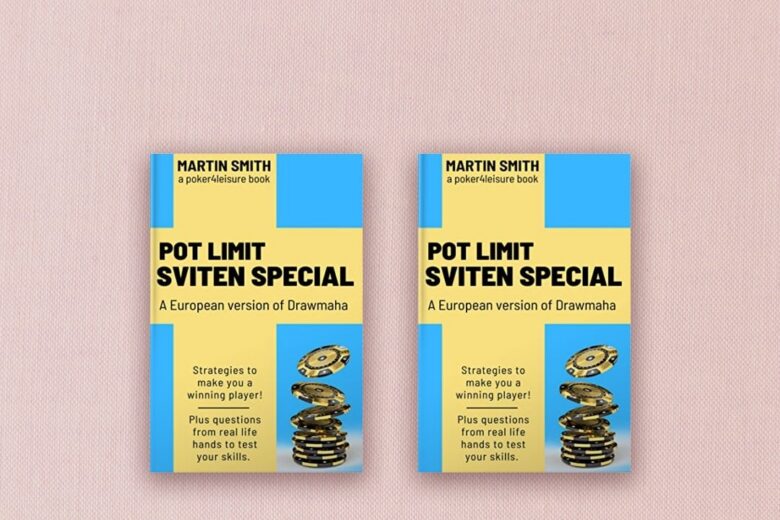
The game is not only shared by organising tournaments or cash games, but recently Martin Smith has published a book about Sviten Special that dives into the world of Sviten Special in detail. If you would like to purchase this book, you can use the following link.
Optimal Strategy
As Sviten Special is a split pot game, you have to be very careful about which hands you start with. Ideally you want a hand that has the possibility of scooping (winning both halves of the pot), which is not easy, but at the very least you want to start with hands that have have a high chance of winning half the pot.
The best hands to start with to have a reasonable chance of winning both halves of the pot include straights and two pairs, as these are already strong hands for the draw pot and have chances to take down the Omaha as well.
Experts of Sviten have pointed out that while most players will be going for the Omaha hand first and the Draw hand second, the better strategy is to try and start with as good a draw hand as possible. This is due to there only being one drawing round, as it’s likely that the best drawing hand will still be winning after the draw has been completed. There is less certainty about Omaha hands staying in front of where they started.
Pre-Flop Strategy
- Starting Hands: Focus on strong starting hands with potential to improve significantly through drawing. High pairs, suited connectors, and high cards are valuable.
- Position: Play tighter from early positions and more aggressively from late positions.
Post-Flop Strategy
- Community Cards: Evaluate how the flop interacts with your hand. Consider both immediate strength and potential draws.
Drawing Strategy
- Draw Wisely: Decide which cards to discard based on the potential to improve your hand. Keep in mind the probabilities of completing your draws.
- Bluffing: Use the drawing round to bluff occasionally, discarding fewer cards to represent a strong hand.
- Observation: Watch what everyone else draws to try to get a read on whether they are going for the Omaha pot, the Draw pot, and an idea of how strong they are.
Post-Draw Strategy
- Re-Evaluate: After the draw, reassess your hand strength. Consider how the new community cards may have helped or hindered your opponents.
Final Betting Rounds
- Value Betting: Bet for value if you have a strong hand, aiming to extract maximum value from weaker hands.
- Bluffing: Employ strategic bluffs, especially if the community cards present a convincing story for a strong hand.
Additional Sviten Special Rules
- No Burn Cards
The dealer must not burn any cards during any phase of the game. - Table Size
Sviten Special is best played 6-handed, but it can also be played with a maximum of 7 players. - Dealing Errors (Initial Deal)
If a dealing error occurs during the distribution of the initial five hole cards (e.g., misdealt card), the cards are not exchanged or redealt. The hand continues as dealt. - Draw Phase – Exposed Card Error
If a card is accidentally exposed during the draw phase, the exposed card is reshuffled back into the remaining deck, and the draw continues normally. - Running Out of Cards During the Draw Phase
See below.
Running Out of Cards During the Draw Phase
Depending on the amount of players in Sviten, and due to the fact that players can change up to five cards, it could be so that the 52 cards in the deck are not sufficient. Hence there have to be unique rules how to reshuffle the cards, and when to enter mucked cards back in the deck.
Here are the basic rules and below we will also examplify:
A player cannot receive a card he or she has mucked. Hence, when people declare their discarded cards, they need to keep them in front of them on the table.
Dealer gives a player his or her cards first and then after received, takes the discarded cards into the mucked pile. If the dealers deck runs out of cards, then at that point, dealer takes the mucked pile and shuffles it, excluding all the discarded cards that are still in front of remaining players in the hand which they still have in front of them.
If there are still players to receive cards in the discarding phase after the first reshuffle because the dealer deck went empty, the dealer then needs to repeat that same procedure for each player that still has to discard his or her cards in that phase, until everyone has discarded their preferred cards.
Note: If no players folded before the flop, only the untouched deck remains
Example: A Game with 6 Players (Amount of cards used, extreme example)
- 6 players have received each five cards. (30 cards in the game)
- Dealer: Without burning cards puts out flop. (30 cards in player's hand, 3 cards on board)
- All 6 players in this example remains after betting round.
- All players declare their discards, and puts these cards in front of them.
- 19 cards remain in the untouched deck
Player 1 wants to draw 5 cards
→ Dealer gives 5 cards from the untouched deck (14 cards remaining in untouched deck)
→ Dealer collects 5 discarded cards into the muck pile (Muck pile contains 5 cards)
Player 2 wants to draw 5 cards
→ Dealer gives 5 cards from the untouched deck (9 cards remaining in untouched deck)
→ Dealer collects 5 discards into the muck pile (Muck pile contains 10 cards)
Player 3 wants to draw 5 cards
→ Dealer gives 5 cards from the untouched deck (4 cards remaining in untouched deck)
→ Dealer collects 5 discards into the muck pile (Muck pile contains 15 cards)
Player 4 wants to draw 5 cards (And here comes the tricky part)
→ Only 4 cards remain in the untouched deck
→ Dealer gives those 4 cards, reshuffles the muck pile that has 15 cards included, and deals the 5th card
→ Then collects Player 4’s 5 discarded cards into the muck pile
→ Dealer reshuffles the discarded cards and the current untouched deck thus creating a "new" untouched deck with 19 cards.
Player 5 wants to draw 3 cards
→ 19 cards remain in the untouched deck, 0 cards in the muck pile.
→ Dealer gives 3 cards from the untouched deck (16 cards remaining in untouched deck)
→ Dealer collects 3 discards into the muck pile (Muck pile contains 3 cards)
→ Dealer reshuffles the discarded cards and the current untouched deck thus creating a "new" untouched deck with 19 cards.
Player 6 wants to draw 4 cards
→ 19 cards remain in the untouched deck, 0 cards in the muck pile.
→ Dealer gives 4 cards from the untouched deck (15 cards remaining in untouched deck)
→ Dealer collects 4 discards into the muck pile (Muck pile contains 4 cards)
→ Dealer reshuffles the discarded cards and the current untouched deck thus creating a "new" untouched deck with 19 cards.
- Dealer: Without burning cards puts out turn. (30 cards in player's hand, 4 cards on board, 18 cards in untouched deck)
- Dealer: Without burning cards puts out River. (30 cards in player's hand, 5 cards on board, 17 cards in untouched deck)
General Tips
As with any form of poker, there are key skills that you need to master to become a successful Sviten Special player. You should always pay close attention to opponents' betting patterns and tendencies. It’s easier to do this when you’re not involved in a pot and a much better use of passive table time than constantly checking your Whats App messages.
Be ready to adjust your strategy based on the dynamics of the table and the tendencies of your opponents. Easier said than done, but if you follow the action on the table rather than watching sports on the poker room TV, you have a great chance to employ winning strategies when you spot leaks in your opponents games.
Perhaps one of the hardest things to successfully achieve in poker is letting go of hand that you really like, even if there’s a good chance it is beaten. Exercising discipline in your hand selection and being willing to fold when necessary is an important skill to have when playing Sviten Special, where pots can get very big very quickly.
Similar Poker Games
Sviten bears a striking resemblance to the already mentioned Drawmaha, and there are also reports of a very similar game being played in Canada in the 1980s under the name Celestial Poker. These games may well have developed independently in different locations, but that there was some indirect awareness of other variants when Sviten was created.
Despite their close similarity, there is a key rule variation that sets Sviten apart from Drawmaha. This difference concerns the drawing round: in Sviten, a special procedure applies when a player chooses to draw only one card. Notably, when Sviten was first played in Stockholm, this one-card rule variation did not exist and was introduced later, suggesting a natural evolution of the game rather than a fully fixed ruleset from the outset.
Celestial Poker, the Canadian game that is almost identical to what is now known as Sviten Special, may also have played an indirect role in inspiring modern bomb pots, which have become popular in recent years. In one reported variant of Celestial Poker, certain hands would feature a different betting structure: each player was required to post an obligatory bet equal to five times the usual big blind before any cards were dealt. The flop would then be dealt immediately, followed by the first real betting round. This procedure is effectively identical to how contemporary bomb pot cash games are played today.
There are also anecdotal indications of how Sviten may have reached the United States. One of the rumours that goes around in Las Vegas is that Greg Raymer brought the game to the U.S. after playing it in a private game with a Swedish player. It is likely that the name was changed at that point (to Drawmaha), possibly to make the game more approachable or easier to understand for an American audience.
This may help explain some of the naming confusion that still exists. Some players refer to what is commonly known as Sviten Special as “Drawmaha,” while the version without the one-card open rule is sometimes called “Dramaha.” These overlapping names further suggest that the game spread organically, adapting slightly as it moved between players, locations, and poker cultures rather than following a single, centralized origin.

Frequently Asked Questions
Are there Burn Cards in Sviten Special?
In Sviten Special, there are no burn cards at any stage. Modern plastic cards are difficult to mark, so burning a card is unnecessary. Therefore, no burn card is used in this game.
The dealer exposes one or more cards by accident pre-flop. Is this considered a misdeal?
No, the initial distribution of five cards per player, along with any exposed card or cards, stays with the player. So in this case, you keep your five cards. You can always fold or exchange up to five cards in the discard phase.
After declining a face-up card when drawing one card, the dealer gives me a face-down card but accidentally exposes it to everyone. What should happen?
The dealer should take the card back, return it to the remaining deck, reshuffle, and then deal you a new face-down card before continuing. This way, the exposed card remains unknown and in play